Where Light Brings Stories to Life
Vintage motion lamps use heat-driven rotating shades to create living scenes. Explore the designs, the makers, and the magic.
(under construction)

About me
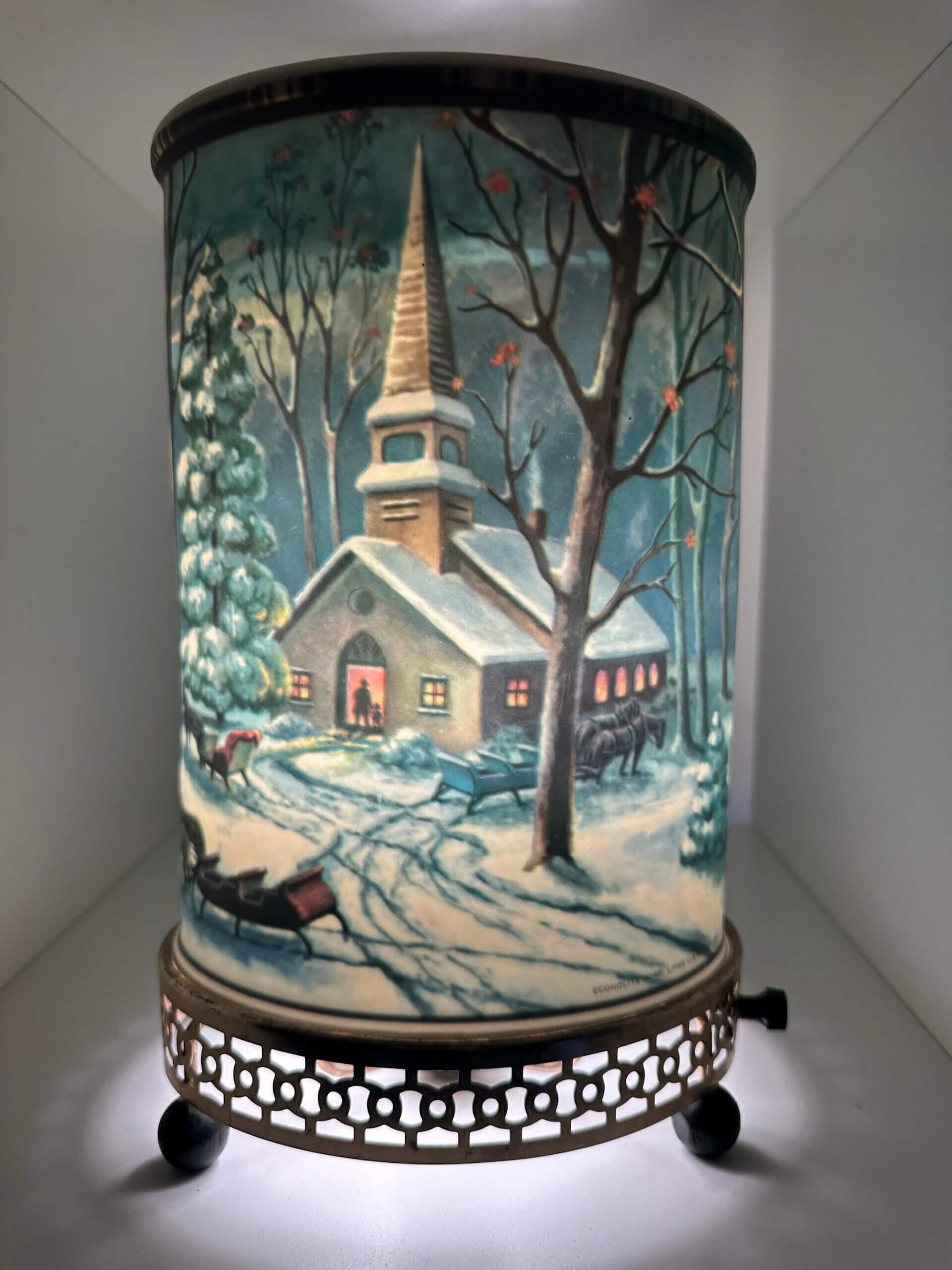
From a very young age, in my native Belgium, I was fascinated by lamps, especially one in particular: the “Snow Scene” by Econolite. Every Christmas, my parents would place it between the nativity scene and the tree. Later, it became my bedside lamp in my university studio. Unfortunately, successive moves took their toll on its fragile plastic.
Much later, I immigrated to Montreal, Canada. And nostalgia took hold of me as I turned 40. With just a few clicks, I was able to track down and buy this lamp that I thought was lost forever. Auction sites did the rest. One thing led to another, and I acquired dozens more, discovering other brands, mechanisms, and eras.
Today, I own over a hundred, and not a week goes by without my searches leading me to buy another one. My goal here is quite simple: to bear witness to a time when these lamps had not yet been eaten alive by our new technologies which leave less and less room for time, which turns like a motion lamp.
Philippe Ysebaert
Passionate collector
About Motion Lamps
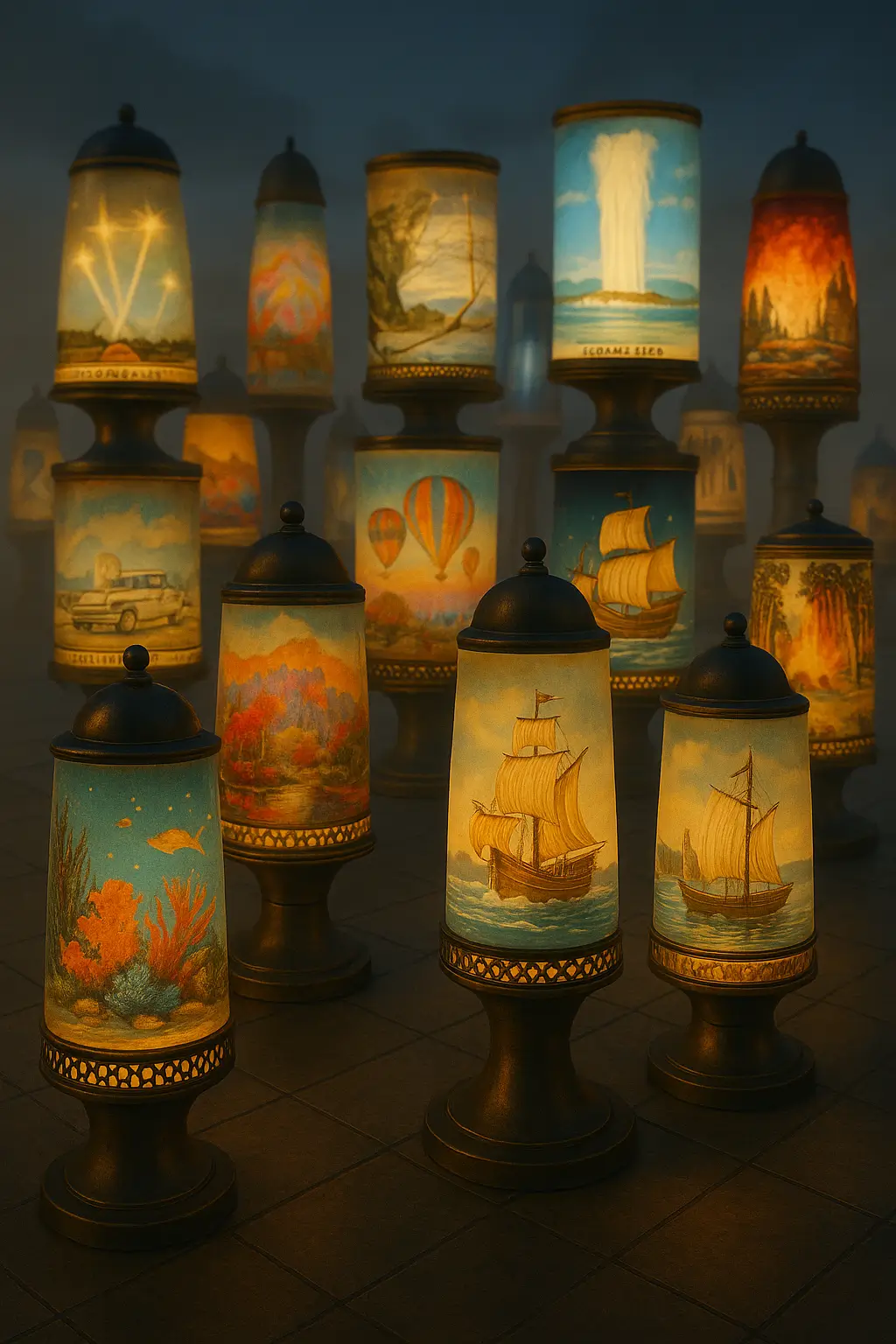
Motion lamps have a long history, and variations of their design are still manufactured today. The golden age of motion lamps was in the 1950s, with Econolite Corporation and L.A. Goodman Manufacturing (later Lacolite Industries) as the leading manufacturers, although brands like National and Scene-In-Action pioneered the field as early as the 1930s. The Econolite Corporation still exists, but the lamp lithograph division was sold in 1961, and production of motion lamps stopped shortly thereafter. The last lamps produced by Econolite before its acquisition were Venice Canal and Mount Fuji, Fountains of Versailles and Eiffel Tower, in 1963, ironically non-US themes.
The rise of motion lamps is closely linked to the popularization of electricity and radio in homes and their decline with the arrival of television in everyone’s living room. Indeed, television, democratized in the 1970s, relegated these lamps to oblivion, much like email rendered fax machines obsolete.
Motion lamps operate on a clever and simple principle based on convection. An incandescent bulb inside the lamp generates heat. This heat causes an inner cylinder, balanced on a pointed metal rod with small fins at its upper end, to rotate. The inner cylinder features patterns that move behind a fixed outer cylinder (or plate) that also displays a scene. The interaction between the two graphic planes creates an illusion of movement, such as flowing water, flickering flames, or floating clouds.
It is interesting to examine the extent to which motion lamps are photos, witnesses to our society, a sort of “Polaroid” of our history. They bear witness to the atmosphere of an era, depicting dramas (forest or city fires), scenes of everyday life (such as waterskiing with friends), events (such as the World’s Fair), or famous places (a tower or an iconic fountain). We must never forget why these lamps were invented, AND ESPECIALLY why they disappeared: the imagination. When television did not exist or had not yet made it into the living room of “the man in the street”, the motion lamp was placed above the radio, in order to bring a little life into the living room and give “an image” to the sound of the radio. In a way, the open fireplace in the main room has given way to the radio (and its motion lamps), which have given way to the television, which has given way to the computer, which has given way to screens of all kinds (cell phones, tablets). After all, there remains one common point in this evolution: having fun with a light!!!!